It's Hype 'Cause it's a Step Change

“There are decades where nothing happens; and there are weeks where decades happen.”— Vladimir Lenin
AI – wow!
Just Google It
I can recall precisely two times in almost 3 decades of technology work where I’ve experienced a step-change in my work process. There have been plenty that I would class as incrementally good changes, but only two with enough magnitude to sit back and marvel at life pre-change vs life post-change.
The first was in 1999. It was also my first year of IT employment. That year that gave us the first installment of The Matrix; the Melissa virus hit IT departments with its macro-into-word-template payload. Half the year was spent changing computer clocks and running Y2K-readiness tests. And it was also the year I discovered Google search.
Young people might not understand that pre-Google Internet life was pretty rough: there were plenty of search engine options, but the typical experience was:
- wading through duplicates,
- dead links,
- next page, next page, next page
- until finally you got something of some use.
With the new Google search engine, you could just Find What You Want (TM). A 15-minute search exercise became a 15-second search exercise. It felt like a step change.
In between times technology marched on: faster hardware, better IDEs, hosted infrastructure, better version control, better package managers, new programming languages. Yep, lots of valuable improvements, but they all seemed incremental, rather than a sudden difference. (Yes iPhone-like mobile was huge culturally, but didn't really shift the work needle for my particular job.)
Just ChatGPT It
And so it remained. Until early 2023. As the world recovered from the disruption of the global pandemic, a new chat service was taking the tech world by storm. My first test of ChatGPT was to give it what I'd also considered an arduous task of writing an information privacy policy document. I don't do policy documents much, and so when the "opportunity" comes around, I'm neither well-practised nor well-enthused for the task. In loading up a couple of sentence prompt, and seeing hours of work unfold before me in a matter of seconds, this felt utterly magical. AI - wow! It's finally arrived! And with it, my second step-change: You can just Create What You Want (TM). I'd appreciated incremental improvements in machine learning applications over the years, but this generative AI was a huge. Generating, creating documents, code, tests, diagrams. I branched out to songs, videos - it could do it all. Wow!
If you asked my kids or colleagues, they'd probably say I've deep-ended a bit with AI. The monologues are real. If AI was a 90s hip-hop act, I'd probably have a big clock around my neck and a name like Flava Flav.
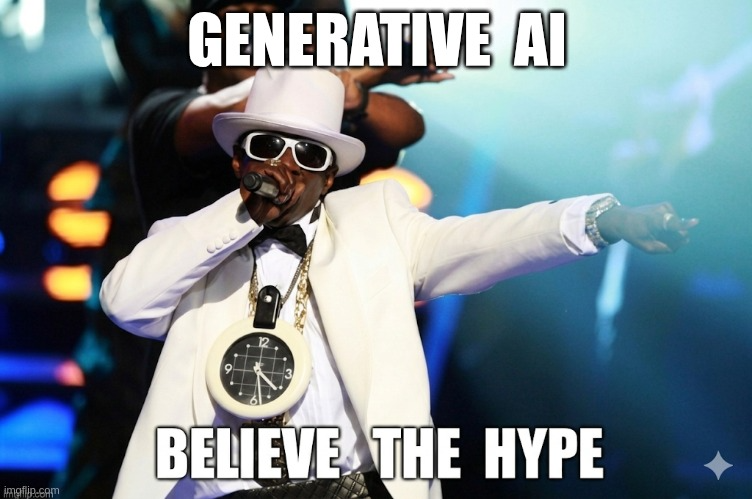
Step Changes Throughout the Ages
I wonder if our forebears had similar vibes? Imagine receiving your first printing press after a life of handcopying - being able to produce 3,000 pages in a day's work instead of 30. What a step change! Imagine the postie who trades in his horse for a new government-issued motorcar—how gangsta would you feel being the mailman that delivers—fast and with style in your new automobile?!?
While there are professions such as the blacksmith that became obsolete over time, many would have just changed with the tech. That copyist-cum-printer would have increased the scope of what he could take on. The postie adds another delivery route to his schedule. Generative AI feels to me like a force-multiplier for a knowledge worker's tasks. I'm more in the amazing-leverage category than the impending-obsolescence category here. Throughout the history of technological advances, we humans tend to move to higher-level and more interesting tasks, rather than sit around en masse twiddling our thumbs because the technology has taken over.
The LLM Revolution
Stating the obvious, it's the production of large volumes of stuff quickly that's the wow factor here. And that stuff—even from the outset—has been anything from adequate to outstanding. So my intervention in the creation process is anything from "minimal" to "well I would have had to spend lots of time on it anyway".
Using generative for the first time in new ways makes you feel like a tech gangsta. Here are a few areas where it's already a been a bit of a force-multiplier for me:
- Document summarisation - LLMs shine here. When I wrote a very simple "summarize the bill before the NZ parliament" prompt for my Democrify app, the one-pagers were incredibly useful in maximizing the knowledge-gained-to-time-spent-gaining-it ratio.
- App production - AI coding agents have enabled me to give birth to or revive projects like Democrify and DefProd that I couldn't have sustained without. The shift from code writer to orchestrator is real for me. There's more "conducting" of AI agents and systems going on. The way I develop software today has changed markedly from a year ago. And a year from today, I'm sure I'll say the same thing again.
- Code Testing - My open source library node-net-snmp was light on tests until AI gave them a big shot in the arm. It's now adequate on tests :-)
- Documentation Creation - Documentation and software developers go together like diets and dessert. I fill my repos now with AI-produced markdowns and designs. I like to implement with an AI agent, and then end a chat with instructions to summarize the new feature into a document for permanent record. It helps me; it helps them.
- Architecture Discussions / Debates - I tend to tire out my colleague with stuff that's important to me and me alone, but LLMs just dive with you right down into that rabbit hole that nobody else cares about - and keep going! It's invigorating!
- Writing Tools - I've long written small bash scripts or Node.js utility tools for certain functions. AI can knock these out with ease! I've even posted about a couple of these: MCP Client REPL and llmshot.
- Vocal Production - Audio models have produced for me vocals passages that I just couldn't pull off myself - when it comes to African-American preacher "sampling" or low-intensity growls (Phoenix Rise), or choir effects (The Day The Thunder Roared), it's just better than me. It just is.
- Video Production - I started producing music videos for the above songs. OK, gotta be honest here, I tried that about 6 months ago, and that was my biggest AI fail. Not to say that it was awful, just that I spent a lot of time trying to prompt my way to character continuity, camera instructions, etc. in about 4 or 5 different tools, and made limited progress. I got some very cool isolated shots, but couldn't stitch together anything coherent enough. Who knows, six months on, this may have all changed!
- Blog Posts - Ha! No I've decided I'm not too much a fan of the common LLM-produced article style, so while producing entire blog posts with AI is alluring, it's not really either (a) what I want to say or (b) how I want to say it. And we need good content authors to write well for the LLMs of the future as well as humans! (I'll come back to that in a future post.) Proof-reading, quote ideas and image generation though—I do open the AI door on some blog things! And I love em-dashes...
- Checklists / Plans - Charged with feeding the family for a long-weekend music festival, I threw an MCP server at Google Sheets and an AI agent created the entire meal plan and grocery shopping list. Honestly, without my wife to organize things, it saved the rest of the family from a weekend of forced fasting—food ain't my forte, but we dined like 17th-century kings!
And yet there are still 2 r's in "strawberry" (GPT-5.2—just yesterday!) It still amazes me the capacity for LLMs to do extraordinary things, but at times botch the basics.
But What About My Job?!?
Two good questions to ask:
"What of your profession can AI do well?", and
"What parts of your profession are human effort and input still valuable?"
The gap that AI can't do so well at (yet!) - that's your opportunity!
And I think the opportunity is huge at the moment, and while it will change in nature over time, and vary per-industry, I think significant opportunity to apply AI well to your profession will remain for some time. In the years at least. But advantage is shifting rapidly to those finding ways to apply AI tools to their craft.
That said, I can identify with anyone feeling overwhelmed in the midst of the AI hype. I was recently reading how this guy gave vague instructions to his AI agent army, came back a day later to a fully-built app. Another guy is so engaged he gets out his phone at a restaurants and gets his remote agents to code up features between bites. And the other guy that got his Openclaw instance to code up a trading bot, make $10,000, and book him a trip to the Bahamas with the profits, all while he slept! OK, I made that last one up. But the first two were from actual social media posts. They may also be true.
I've found it really easy to feel utterly left behind on this stuff. I deal with this sentiment by just making small, regular discoveries, doing tests, downloading AI tools or even writing them—with AI help! Or posting about them! Making steady progress is all you can really commit to. I'm not running 100 agents writing software in my sleep. Yet.
Generative AI is a step-change, and these technology moments are rare. You might get two or three in your lifetime. If you're here reading this: This is your moment! Think "opportunity" and dive in!

If you feel like you're overwhelmed in the deluge, start small. It might be to install an AI coding agent (e.g. cursor, Open Code), or run up ollama with a local model, or sign up for an AI API key of your chosing, or write a small MCP server, or a simple agent loop, or slide AI into a regular process where it might help. The great thing is—you can just ask an LLM how to do any of that stuff as well, so it doesn't have to be a lengthy solo struggle (in most cases anyway!)
Concerned, Excited, or a Bit of Both?
There are a number of concerns about the generative AI wave we ride—we've all had discussions and scrolled social media enough to know about these. And they're valid. Workforce obsolescence, energy consumption, AI responsibility/safety, prevention of Skynet—all issues that we're rightfully wrestling with.
But that's for another day and another post. Because today, I'm taking another moment to take a step back, see the step change, and say again:
AI, wow!